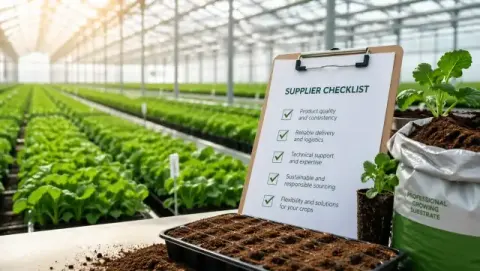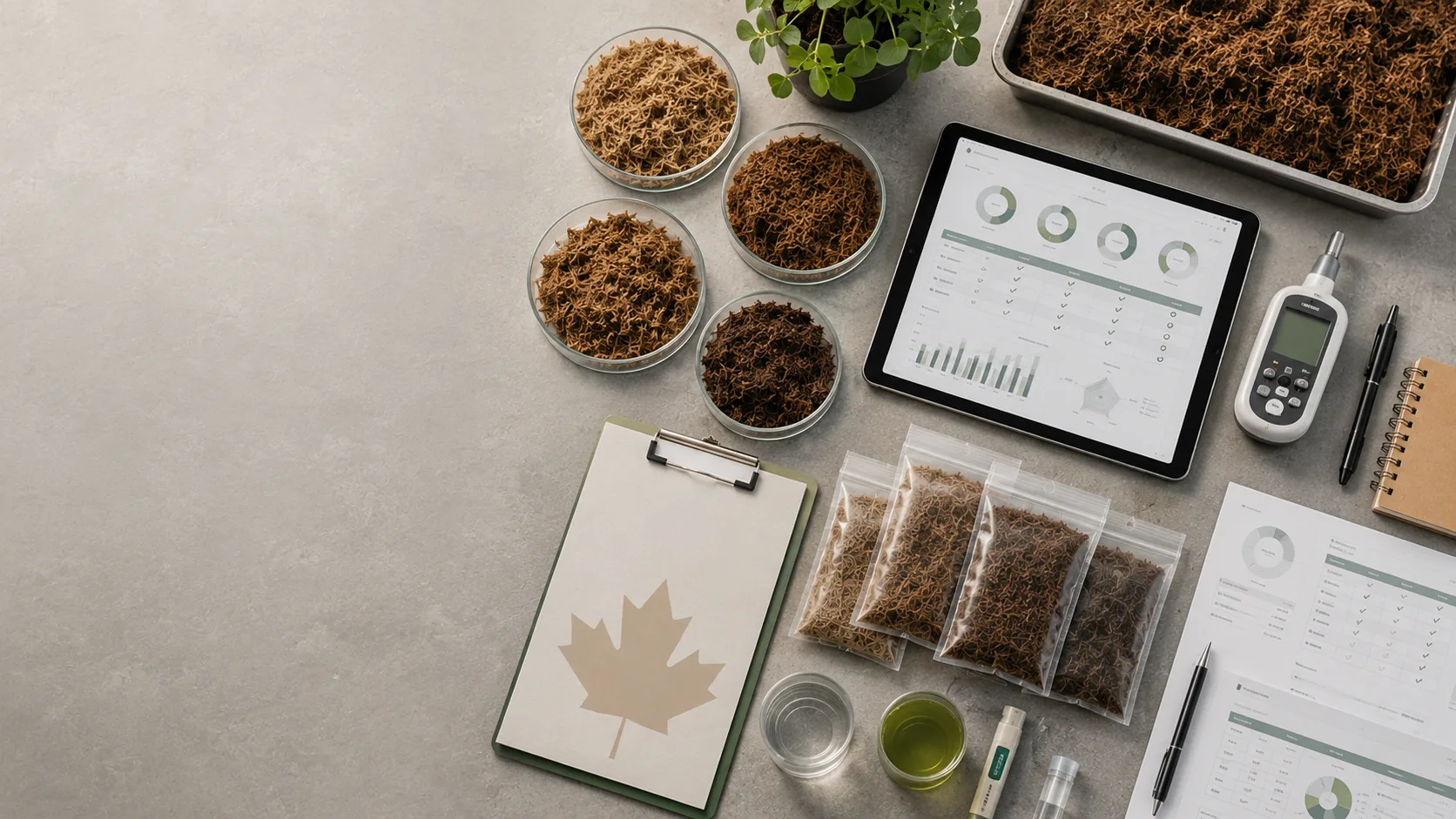
Choosing a Canadian sphagnum peat moss supplier is a production and procurement decision, not only a price comparison. Commercial buyers should evaluate peat type, consistency, moisture condition, bale format, pH behavior, truckload planning, documentation, and whether the supplier can support the crop program behind the purchase.
- A Canadian sphagnum peat moss supplier should be evaluated by production fit, not only by price per bale.
- Large buyers should compare source consistency, moisture condition, bale format, pH direction, logistics reliability, and documentation before seasonal commitments.
- Grower grade peat moss is usually a base material for blending, acidic crop support, or bulk greenhouse supply, not the same thing as a finished growing mix.
- Truckload planning, storage, and filling-line behavior can create hidden cost if they are not reviewed before ordering.
- A good supplier should help buyers decide when raw peat is enough and when a formulated grower mix is the better fit.
Why this supplier decision matters:
Choosing a Canadian sphagnum peat moss supplier is not only a procurement task. For growers, substrate blenders, and distributors, peat moss can become part of the production system. It affects blending behavior, moisture management, pH direction, handling, logistics, and how confidently a team can plan seasonal supply.
A low price per bale can look attractive during quotation. The real cost appears later if the material does not fit the filling line, arrives too close to production, changes moisture behavior between loads, or requires more correction work than expected.
For larger commercial programs, the right question is not simply: who can supply peat moss? The better question is: which supplier can support the volume, format, consistency, documentation, and crop program behind the purchase?
What does Canadian sphagnum peat moss supplier actually mean?
The phrase can describe several different types of suppliers. Some buyers are looking for raw peat moss as a base material. Others need grower grade peat moss in commercial packaging. Some need wholesale peat moss truckload quantities. Others are really looking for a professional growing media manufacturer that can supply finished mixes.
That distinction matters. Raw peat moss and a finished grower mix are not the same purchasing decision. Raw peat gives flexibility for in-house blending, acidic crop programs, and custom formulations. A finished mix may already include structure components, wetting support, pH adjustment, starter fertilizer, perlite, wood fiber, or other formula decisions.
Before comparing suppliers, define what your team actually needs: base material, a product for acidic crop support, a truckload supply program, or a ready-to-use growing medium.
7 checks before choosing a supplier:
1. Source and peat type:
Start by confirming what the supplier is offering. Is the product Canadian sphagnum peat moss, grower grade peat moss, a specific raw peat fraction, or a formulated substrate?
The answer should connect directly to use. A blender may need a reliable base material. A grower may need peat moss for acidic crop support. A distributor may need stable formats and repeatable truckload supply.
2. Consistency between loads:
Consistency is one of the most important buying criteria for commercial programs. Ask how structure, moisture condition, and handling expectations are managed between loads.
Even when peat moss is a natural material, buyers still need predictable behavior. Variation that is acceptable in a small order can become a production issue when the material is used across many batches or filling shifts.
3. Bale format and packaging:
Packaging is not a secondary detail. Bale size, pallet configuration, compression, storage behavior, and unloading process all affect labor and production rhythm.
For wholesale peat moss truckload quantities, confirm how the format fits receiving, storage, mixing, and filling. A technically suitable material can still create cost if the packaging does not fit the operation.
4. Moisture condition and handling:
Moisture condition affects more than weight. It changes how peat moss opens, blends, flows, stores, and responds when used in a substrate program.
Buyers should ask what moisture condition to expect, how the material should be handled after arrival, and whether the production team needs to adjust storage or blending routines.
5. pH direction and crop fit:
Canadian sphagnum peat moss is often valued for acidic crop support and as a base material in custom growing media. But crop fit still needs to be confirmed.
If the crop program needs a specific pH starting point, fertilizer direction, or wetting behavior, a formulated mix may be more appropriate than raw peat. The supplier should help clarify that decision instead of treating every program the same way.
6. Logistics and season planning:
For commercial buyers, logistics reliability can be as important as product specification. Ask about normal lead times, peak-season lead times, truckload planning, and what happens if crop schedules change.
Large buyers should plan early. The best supplier relationship is usually built before the season is urgent, not during the week when the substrate must already be on the production floor.
7. Documentation and support:
Documentation matters for procurement, quality, and internal approval. Ask what product files, specifications, certificates, and contact points are available before placing a larger order.
Support also matters after delivery. If the material behaves differently than expected, the buyer should know who can help review handling, storage, blending, or crop fit.
For some buyers, the strongest supplier is a peat bog to greenhouse supplier: a partner who can connect source, processing, packaging, documentation, and delivery planning into one practical supply conversation.
Common mistakes buyers make:
One common mistake is comparing only price per bale. Price matters, but it does not capture handling, storage, moisture condition, consistency, lead time, or production risk.
Another mistake is confusing raw peat moss with a finished growing mix. Raw peat may be the right choice for in-house blending or acidic crop programs, but it is not automatically the right choice for every grower.
A third mistake is testing too little before committing too much. Buyers should review how the material opens, blends, fills, stores, and behaves under the real production workflow.
When grower grade peat moss is the right fit:
Grower grade peat moss is often a strong fit when the buyer needs a peat moss base for custom formulation, bulk greenhouse supply, acidic crop support, or distribution programs that require a clear product format.
It can be especially relevant for substrate blenders, larger growers with internal mixing capacity, and distributors that need consistent North American peat moss supply.
Buyer example: substrate blender:
A substrate blender may not need a finished mix. The team may already have its own formula, equipment, additives, and quality process. In that case, the important supplier questions are about base material consistency, bale format, moisture condition, delivery timing, and whether the peat behaves predictably in the blender's own process.
For this buyer, the best supplier conversation is technical and operational. The buyer should ask how the material opens after storage, how it performs in mixing, what documentation can be supplied, and how future orders can be planned around peak demand.
Buyer example: commercial grower with in-house mixing:
A large grower with in-house mixing may use peat moss as one component in a crop-specific program. The production team may add perlite, fertilizer, wetting support, or other amendments based on crop needs.
For this buyer, peat moss selection should be tested under the real irrigation strategy and container format. The team should compare dry-down, root-zone response, pH behavior, fill consistency, and how much correction work is needed after transplant or early crop establishment.
Buyer example: distributor or regional market supplier:
A distributor may care less about one crop trial and more about dependable packaging, repeatable supply, clear product positioning, and whether the supplier can support customer questions. For this buyer, truckload timing, pallet configuration, product naming, and sales documentation can be just as important as the peat specification.
A distributor should clarify which customer segment the product serves: growers who blend in-house, growers who need acidic crop support, or customers looking for a finished growing medium. This prevents the product from being sold into the wrong use case.
When a formulated mix may be better:
A formulated mix may be the better choice when the crop needs a specific drainage profile, air space, fertilizer direction, wetting behavior, or pH-adjusted starting point.
For example, peat and perlite grower mixes may fit programs that need stronger drainage and root-zone air movement. Seed and plug mixes may fit propagation workflows. Organic mixes may fit herbs, leafy greens, and lower-input greenhouse programs.
A good supplier should help the buyer make this distinction. The goal is not to force every program into raw peat moss. The goal is to choose the material or mix that reduces production risk.
Questions to ask during the first supplier call:
What product format is most common for similar buyers? What lead time should be expected during peak season? Which bale or pallet formats fit truckload planning? What product documents are available before ordering? Who should the grower contact if handling or moisture behavior differs from expectation?
The answer to these questions tells a buyer more than a generic product description. A strong supplier should be comfortable discussing real workflow details, not only general product benefits.
Practical buyer takeaway:
A reliable Canadian sphagnum peat moss supplier is not only a source of peat. The right partner helps buyers understand product fit, consistency, packaging, logistics, documentation, and whether grower grade peat moss or a formulated mix is the better commercial decision.
Before placing a seasonal order, align procurement, production, and growing teams around one checklist. Confirm the use case, test the material in the real workflow, review logistics early, and keep the supplier involved before the season becomes urgent.
Recommended ASB products
These products are commonly evaluated with the strategy covered in this article.
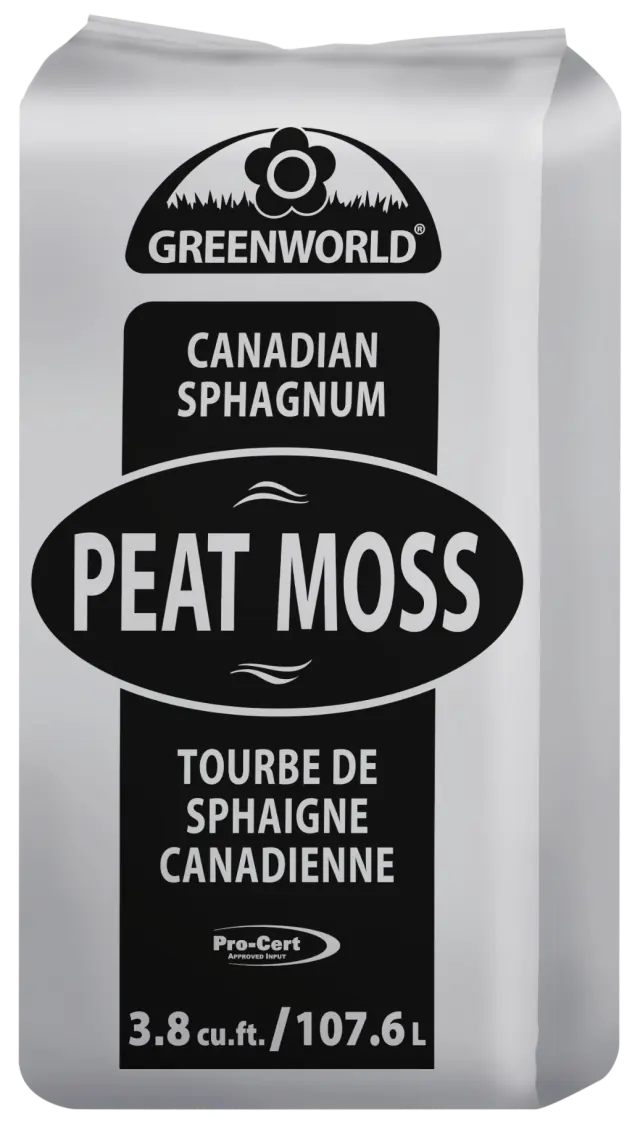
ASB Growing Grade Peat Moss
Canadian sphagnum peat moss for North American growers, blenders, distributors, and bulk procurement programs.
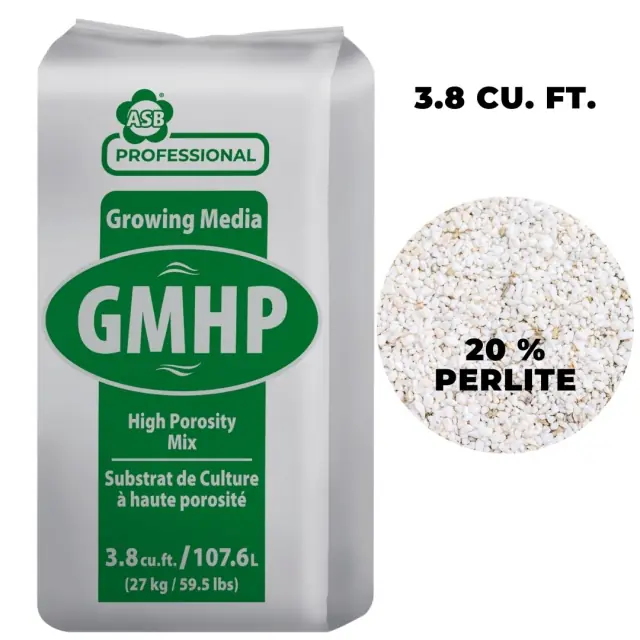
ASB Grower Mix 20
A useful next step when the crop program needs a ready-to-use peat and perlite grower mix instead of raw peat moss.
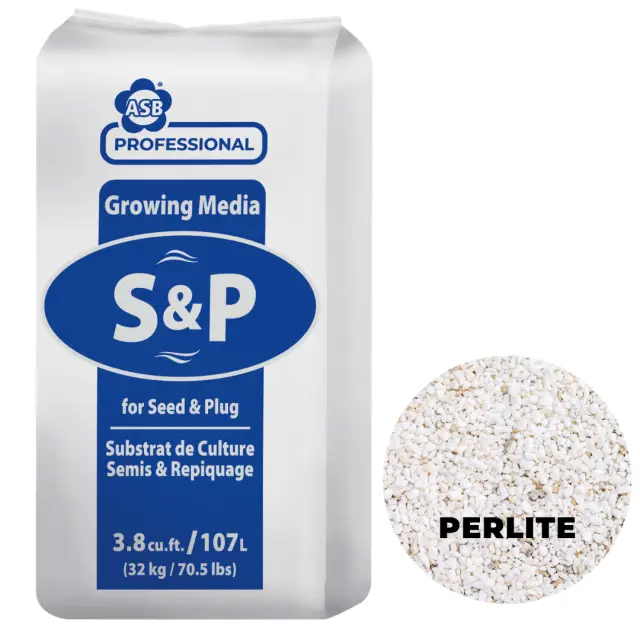
ASB Seed & Plug Mix
A formulated propagation option when buyers need a finished mix for trays, plugs, liners, and young plant programs.
Supplier evaluation checklist
| Criteria | What to ask | What a strong answer should clarify |
|---|---|---|
| Peat type and intended use | Is this raw peat, grower grade peat moss, or a finished substrate mix? | The supplier should explain whether the product is a base material, acidic crop support, blending component, or ready-to-use growing medium. |
| Consistency | How consistent is structure, moisture, and handling between loads? | The supplier should discuss source consistency, processing expectations, quality checks, and how variation is communicated. |
| Packaging | Which bale formats, pallet formats, and truckload quantities are available? | The answer should connect bale format to storage, filling-line handling, unloading, and seasonal ordering. |
| Crop and pH fit | Will this peat moss fit acidic crops, custom blending, or base mix formulation? | The supplier should help the buyer match pH direction and structure to the crop program instead of treating all peat as interchangeable. |
| Logistics | How early should truckload or seasonal planning begin? | The supplier should define lead times, delivery windows, documentation steps, and escalation contacts before the season starts. |
FAQ
What should buyers check before choosing a Canadian sphagnum peat moss supplier?
Buyers should check peat type, structure, moisture condition, pH direction, bale format, truckload planning, documentation, and whether the supplier can support the crop program or blending workflow.
Is grower grade peat moss the same as a finished growing mix?
No. Grower grade peat moss is usually a base material or peat moss product used for blending, acidic crop support, or bulk supply. A finished growing mix may already include materials such as perlite, wood fiber, fertilizer, wetting agent, or pH adjustment.
Why does moisture condition matter in bulk peat moss supply?
Moisture condition affects handling, storage, blending behavior, filling-line flow, and how the material responds when it is incorporated into a growing media program.
When should buyers choose a formulated grower mix instead of raw peat moss?
A formulated mix is usually better when the buyer does not want to blend in-house or when the crop needs a specific structure, drainage profile, fertilizer direction, wetting behavior, or pH-adjusted starting point.
Comparing peat moss supply for a North America program?
The ASB Professional North America team can help compare grower grade peat moss, bale formats, truckload planning, and whether a raw peat or formulated mix is the better fit for your crop program.
This article is part of the ASB Professional Blog and highlights topics across events, sustainability, and technical growing media expertise. ASB Greenworld Eesti is listed as a member of the Estonian Peat Association (Eesti Turbaliit).
It helps customers and partners follow company developments, market activity, and product-related topics.
ASB Professional Editorial Team